
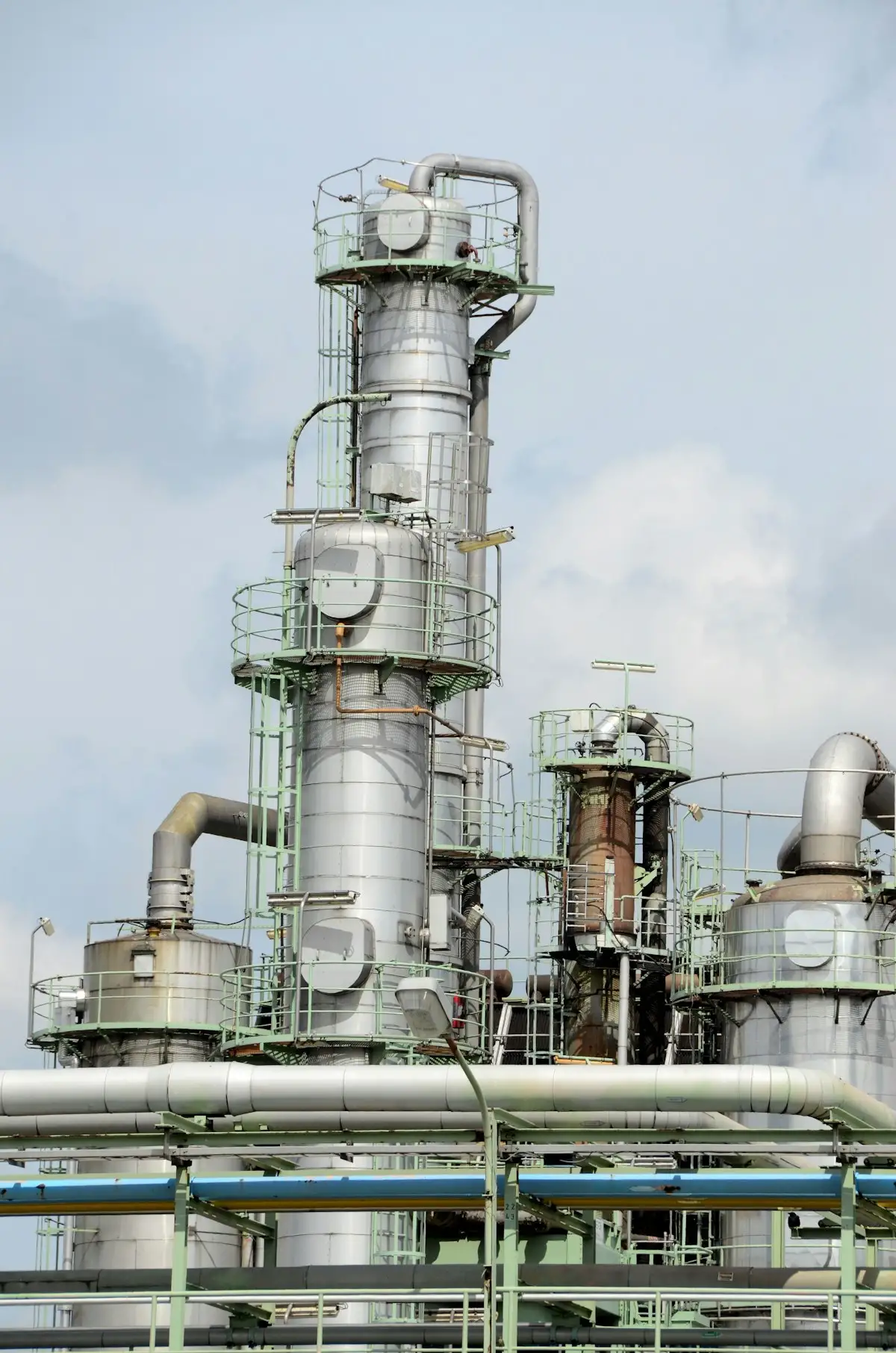
The most common misconception about used lubricating oil is that it is worn out. It is not. Base oil does not degrade in service the way an additive package does — what leaves the sump is mostly the same hydrocarbon that went in, carrying four kinds of passenger: water and fuel dilution, spent additives, oxidation products, and wear metals.
Re-refining is the business of removing those four in the right order. Take them out of order and you destroy the product you are trying to recover.
Stage 1 — Dehydration
Incoming oil is heated under mild vacuum to strip free and emulsified water plus any light-end fuel dilution. This has to happen first: water flashing inside a vacuum column at temperature will carry oil overhead and upset the whole separation. Typical incoming water content runs anywhere from a fraction of a per cent to several per cent, depending on how the oil was stored before collection.
Stage 2 — Vacuum distillation
The dehydrated oil is separated by boiling point under reduced pressure. Pressure is the entire point. Lube-range hydrocarbons begin to crack somewhere above 350 °C, so at atmospheric pressure the temperature needed to boil the heavy fractions would break the molecules apart. Under vacuum, the same separation happens far below the cracking threshold.
The column cuts the feed into light, medium and heavy lube fractions — broadly the SN150, SN500/600 and SN900 ranges. Where the cut points sit is what sets the viscosity of each finished grade, and holding them steady is why one batch of SN600 matches the last.
Stage 3 — Thin-film evaporation
What leaves the bottom of the vacuum column is a heavy mixture: recoverable lube still bound up with asphaltenes, spent additive residue and metals. A thin- or wiped-film evaporator spreads that stream across a heated surface as a film only a fraction of a millimetre thick, so the residence time at temperature is measured in seconds rather than minutes.
Short residence time is the whole trick. It lets you pull the last usable lube fraction away from the residue without cooking it. The residue that remains is the feedstock for our sustainable bitumen extender — it is a product, not a waste stream.
Stage 4 — Finishing
Distillation separates by boiling point, which means anything that boils in the lube range comes over with the lube: colour bodies, residual acidity, some sulphur and nitrogen compounds. Finishing removes them, either by clay polishing — contacting the oil with activated bleaching earth that adsorbs the polar compounds — or by hydrotreating, which converts them chemically under hydrogen pressure.
Clay is simpler and lower in capital cost; hydrotreating gives a more stable oil and produces no spent clay to dispose of. Which one a plant runs is the single biggest determinant of its finished colour and oxidation stability.
What comes out
An API Group I base oil: under 90% saturates, over 0.03% sulphur, viscosity index between 80 and 120. Chemically it is the same product as a Group I refined from crude, and it is verified the same way — ten ASTM methods on every batch, from appearance and colour through to neutralisation value and water content.
The group is a property of the finished oil, not of its feedstock. That is the sentence the whole industry turns on.